
Instrument description
WAY questionnaire
Adaptive personality assessment at the level of behavioural descriptions
WAY examines how characteristic different behavioural descriptions are of a respondent relative to one another. Rankings of groups of four descriptions are combined into a personal profile that retains the estimated position of all 140 statements. Interpretation starts from this detailed profile.
140 behavioural statements · Four-item rankings · Adaptive administration
What distinguishes WAY?
Conventional personality questionnaires combine responses to several statements into scores on predefined scales. WAY’s primary output is the relative position of each behavioural statement, together with uncertainty about that estimate. Individual differences between statements can therefore be examined before they are summarised. A narrative description or interview guide can subsequently be derived from the profile for a particular purpose.
How you complete WAY
Each screen presents four statements. The respondent chooses the most self-descriptive statement, then the most self-descriptive of those remaining. This continues until all four are ranked. There are no right or wrong answers: the task concerns typical behaviour.
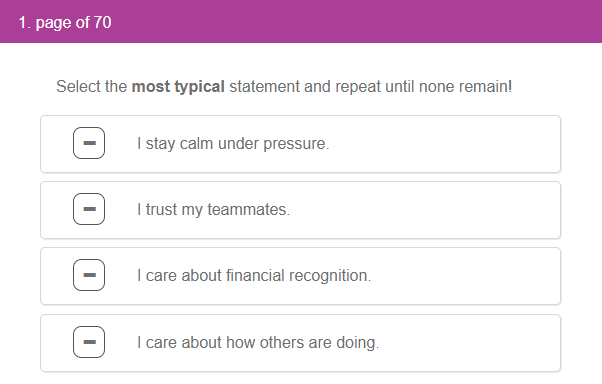
- Read four descriptionsConsider how characteristic each statement is of your usual behaviour.
- Choose the most typicalSelect the statement that describes you best.
- Rank the remaining descriptionsRepeat the choice among the statements that remain.
- Continue to the next groupThe answers given so far help determine the next four statements.
One administration of the 140-statement version described here contains 70 groups of four; every statement appears at least once. The 70 screens do not represent 70 different statements: groups are drawn from the item pool, and statements may appear more than once.
From answers to a personal profile
A complete four-item ranking determines six pairwise comparisons. Rankings across groups jointly inform the estimated position of each statement within the respondent’s profile. PPO (Probabilistic Preference Ordering) describes this person-specific ordering and the uncertainty of the estimates.
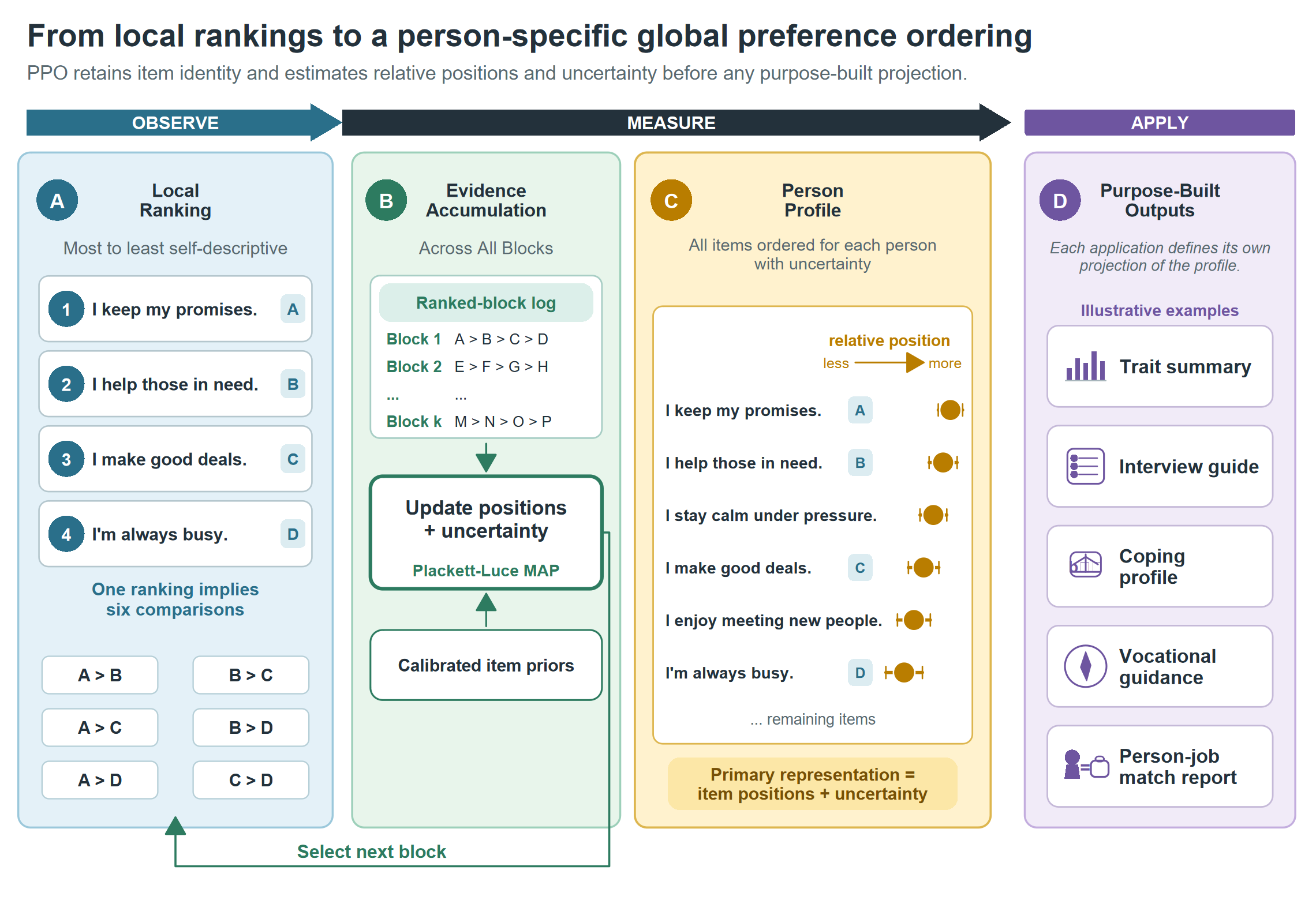
On a small screen, scroll the figure horizontally or open it at full size.
Open the workflow at full sizeScoring and adaptation
Relative scores
The Plackett–Luce model treats a ranking as a sequence of choices: first the most self-descriptive statement, then a choice among those remaining. It combines the accumulated rankings to estimate a relative score for every statement. The implementation described here also uses calibrated prior estimates and records uncertainty alongside each score.
Selecting the next group
The system selects the next group using the answers given so far. It seeks comparisons that may provide further information about the profile. Adaptation changes the questioning procedure; by itself, it does not establish greater reliability or validity.
Background on the ranking model: Turner et al. (2020), Modelling rankings in R: The PlackettLuce package.
What the results mean
A higher score means the model estimates a description to be more characteristic of the respondent than descriptions with lower scores. The score is not a percentage, a performance rating or, on its own, a population percentile. The result summarises self-description; it is not direct observation of behaviour or a diagnosis.
The numerical profile and the AI-generated narrative report are produced in separate steps. The profile is the measurement estimate derived from answers; the narrative is an interpretation of that profile. Narrative accuracy can therefore be evaluated separately, and agreement with a report does not replace evaluation of the measurement.
Version and citation
- Author
- Balázs Klein
- Description version
- 1.0 · 140 statements · 70 four-item groups
- Date
- 18 October 2026
Suggested citation
Klein, B. (2026). WAY questionnaire: Instrument description (Version 1.0). PeopleTest.
https://peopletest.net/en/work/way/Download the dated description (PDF)